



Choosing between a closure wig and a frontal wig comes down to lace coverage, parting space, and how much of the front hairline you want to style. A closure concentrates lace around the top-front area, while a frontal extends lace across the front hairline.
The better option depends on your experience, preferred hairstyles, maintenance routine, and budget. This guide explains the differences and helps you choose a structure that fits everyday wear.
Table of Contents
- What Is a Closure Wig?
- Common Closure Sizes
- What Styles Can a Closure Support?
- What Is a Frontal Wig?
- 13x4, 13x5 and 13x6 Frontal Sizes
- What Styles Can a Frontal Support?
- Closure Wig vs Frontal Wig: Key Differences
- Closure vs Frontal Comparison Table
- Luvme Closure and Frontal Wigs to Compare
- Conclusion
What Is a Closure Wig?
A closure wig has a smaller lace section sewn into the top-front area of the cap. Individual hairs are ventilated into the lace to create a scalp-like part, while the remaining hair is usually attached to a structured cap with machine-made wefts.
Because the lace does not normally extend from ear to ear, there is less delicate material to trim, blend, wash, and protect.

Closure lace is concentrated around the top-front parting area.
Closure wigs are popular with beginners and daily wearers because they can create a convincing part without requiring a full frontal installation. Many include pre-cut lace, elastic bands, adjustable straps, combs, or drawstring support. However, “closure” describes the lace structure, so not every closure wig is automatically glueless.
Current Luvme closure wigs include different lace sizes, textures, colors, lengths, and cap constructions for both simple and more flexible parting.
Common Closure Sizes
Common closure sizes include 4x4, 5x5, and 7x6. The first number describes the approximate width of the lace, and the second describes its depth from the hairline toward the crown.
Best for a simple central part and users who want the smallest, easiest-to-manage lace area.
Provides more room for a longer middle part, soft side part, or slightly curved part.
Supports deeper side parts and C-parts while remaining easier to maintain than most frontals.
Some products use 2x6 or extended closure designs for a specific parting or hairline effect. Check the cap diagram rather than relying only on the product name. For a broader explanation, see the lace wig size guide.
What Styles Can a Closure Support?
A closure works well for middle parts, soft side parts, C-parts, bobs, layered cuts, straight styles, waves, and curls. Larger closures provide more room to shift the part, but the visible scalp effect must remain inside the lace area.
- Middle parts: Suitable for 4x4, 5x5, and 7x6 closures.
- Soft side parts: Easier with a 5x5 or wider closure.
- C-parts: Usually better supported by a 7x6 closure.
- Bobs and layered cuts: Work well because the lace supports a natural top part.
- Curly and wavy styles: Add fullness without requiring the full hairline to remain visible.
A standard closure is less suitable for fully exposing both temples or pulling the entire front sharply backward.
What Is a Frontal Wig?
A frontal wig has lace extending across the front hairline, usually from one ear area to the other. This wider section creates a more complete front-hairline effect and gives the wearer more room to place parts across the front.
Hair behind the frontal is usually attached to a structured cap, so a frontal is different from a full lace or 360 lace wig.

Frontal lace extends across a wider section of the front hairline.
Traditional installations may use adhesive, but many current frontals are designed for glueless wear. Pre-cut lace, elastic support, combs, adjustable straps, and drawstring caps can reduce preparation. Even so, a frontal needs careful alignment around the forehead, temples, and ear tabs.
The Luvme frontal wig collection includes 13x4, 13x5, and 13x6 designs across straight, wavy, curly, bob, highlighted, and long styles.
13x4, 13x5 and 13x6 Frontal Sizes
Provides ear-to-ear coverage with enough depth for common middle and side parts.
Adds slightly more depth behind the front hairline for additional styling room.
Reaches farther toward the crown and better supports deep side parts and long C-parts.
Lace depth does not guarantee unrestricted parting. Ventilation direction, density, preset parts, and cap construction still affect how naturally the hair moves.
What Styles Can a Frontal Support?
A frontal supports middle parts, deeper side parts, C-parts, face-framing looks, front braids, and styles that move hair away from the forehead. It is especially useful when the temples and more of the front hairline will remain visible.
Closure Wig vs Frontal Wig: Key Differences
Lace Coverage
A closure concentrates lace around the top-front parting area. A frontal covers a wider section across the front hairline, creating more styling freedom but also more lace to position and maintain.
Parting Space
A 5x5 closure supports common everyday parts, while a 7x6 provides deeper options. Frontals offer a broader front range, and a 13x6 generally provides more depth than a 13x4.
Hairline Styling
A closure can look highly realistic around the part but normally keeps the temples covered. A frontal is better when the full front hairline or hair brushed away from the face is central to the style.
Installation
Closures are usually easier to align because the lace area is smaller. Frontals require more attention across the forehead and ear areas. Glueless caps simplify the process but still require careful placement.
Maintenance
A closure has fewer lace edges to clean and protect. A frontal needs more detailed hairline care, especially near the temples and ear tabs. Adhesive use also adds removal and residue-cleaning steps.
Comfort
Comfort depends on cap size, tension, breathability, comb placement, and lace softness. A closure may feel simpler, while a correctly fitted glueless frontal can also be comfortable.
Price
Comparable frontals often cost more because they use a larger hand-ventilated lace area. Length, density, color, texture, lace type, and cap technology also affect the final price.
Natural Appearance
A frontal has an advantage when the complete front hairline is visible. A closure can look equally realistic within its parting area when the lace, knots, cap fit, and scalp match are right.
Closure vs Frontal Comparison Table
| Feature | Closure Wig | Frontal Wig |
|---|---|---|
| Lace coverage | Smaller top-front section | Front hairline, usually ear to ear |
| Common sizes | 4x4, 5x5, 7x6 | 13x4, 13x5, 13x6 |
| Parting | Middle, side, or C-part depending on size | Wider front parting range |
| Hairline styling | Best around the central part | Better temple and full front visibility |
| Installation | Usually easier | Requires more precise placement |
| Maintenance | Usually lower | Usually higher |
| Glueless options | Common | Also widely available |
| Best for | Beginners and low-maintenance daily wear | Deep parts and greater front flexibility |
Neither option is universally better. A closure is usually the more practical starting point, while a frontal is useful when the front hairline is an important part of the finished look. For a closer size-based comparison, read 7x6 Closure Wig vs 13x6 Frontal Wig.
Luvme Closure and Frontal Wigs to Compare
The following products show practical choices for beginners and regular daily wear. Pre-cut lace and glueless cap features can shorten preparation, but always confirm the listed cap size and security design.

Beginner Friendly 200% Density Afro Curly Wig
A pre-cut, glueless closure with an adjustable one-size cap for beginners who want full natural-textured curls.
View Product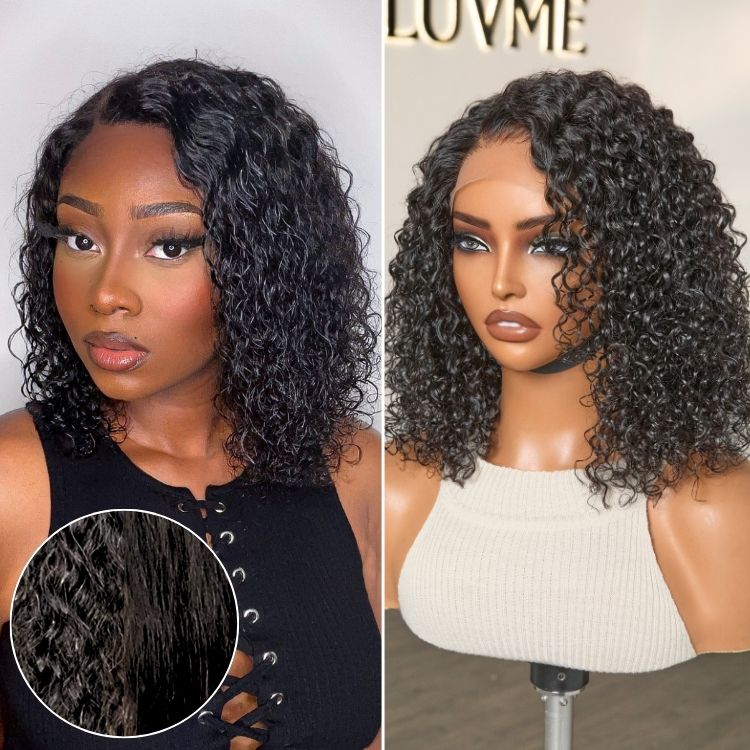
Wet and Wavy Water Wave 5x5 Closure Wig
A side-part closure with pre-cut lace and wet-and-wavy texture that requires relatively simple front placement.
View Product
PreMax Silky Blunt Cut Bob 13x4 Frontal Wig
A short, pre-cut, glueless frontal that provides wider hairline coverage without the maintenance of long hair.
View Product
AiryFit Silky Straight 5x5 Closure Wig
A lightweight middle-part option with a polished texture suited to work, errands, and repeat daily styling.
View Product
180% Density Body Wave / Straight 13x4 Frontal Wig
A versatile long frontal for wearers who want either smooth straight styling or soft body wave.
View Product
NatureMAX Loose Wave 13x6 Frontal Wig
A glueless drawstring-cap option with deeper parting room for regular wearers who want more front styling flexibility.
View ProductConclusion
Choose a closure wig when your priorities are easier installation, lower maintenance, a natural part, and a routine that works well for beginners or everyday wear. Choose a frontal when you want broader hairline coverage, deeper side parts, and more freedom to expose or reshape the front of the hairstyle.
The best result comes from matching the lace structure to the styles you will actually wear. A well-fitted closure can look more natural and feel more practical than a frontal you do not want to maintain. If you prefer a frontal-like effect with less upkeep, a larger closure can offer a useful middle ground. You can also learn how to make a closure look more like a frontal through styling and careful lace placement.


 + 1
+ 1
 + 1
+ 1
 + 44
+ 44