



Choosing between human hair and synthetic crochet hair affects more than the final appearance. The material can change how the hair moves, how much it costs, how it feels during wear, and whether it can be washed, refreshed, or reused after removal. Human hair is often preferred for its softness and styling flexibility, while synthetic hair is popular for its lower upfront cost and preset texture.
Neither material is automatically right for every wearer. The better choice depends on how natural you want the finished style to look, how long you plan to wear it, how much maintenance you can manage, and whether you want a temporary look or hair that may support more than one installation.
Table of Contents
What Is Human Hair Crochet Hair?
Human hair crochet hair is extension hair made from real human hair and installed through a cornrow or braided foundation with a crochet needle. The hair may be sold in loose bulk sections, pre-looped pieces, or pre-separated strands prepared for boho braids, Miracle Knots, loose crochet styles, and other protective looks.
Human hair does not mean maintenance-free hair. The strands can still become dry, tangled, or weighed down by heavy products. The braid base also needs to remain clean and fully dry. Its main advantage is that the hair generally gives the wearer more control over how the texture looks after installation.
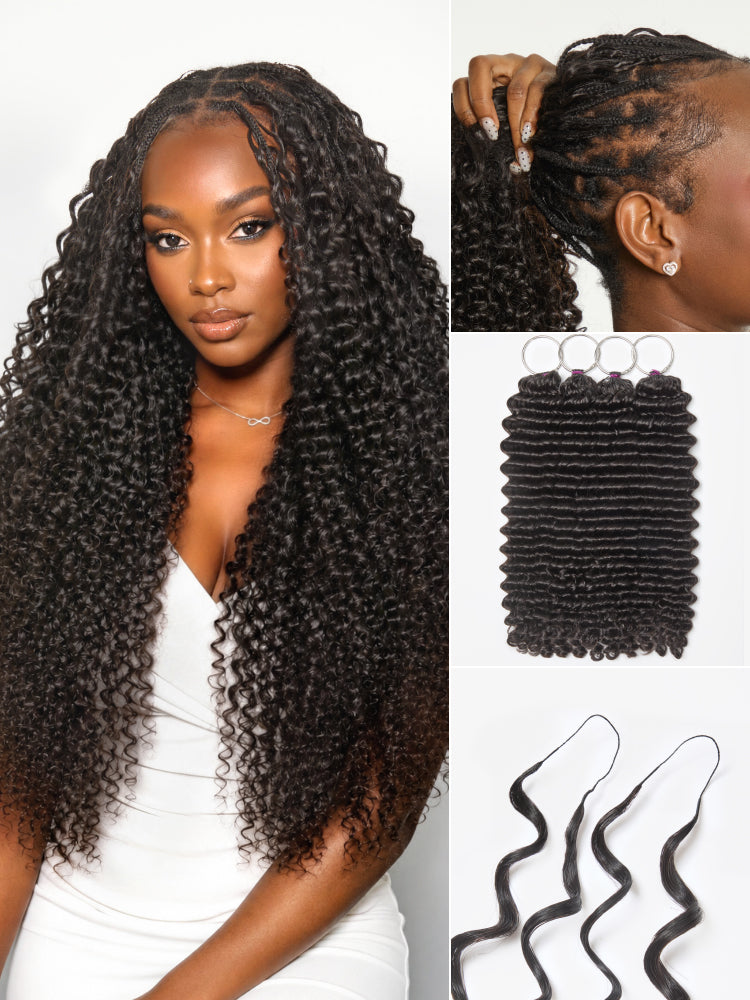
Crochet Extension for Miracle Knots and Boho Braids
This pre-separated crochet extension offers a practical example of human hair crochet. It is designed for protective styles that need soft loose pieces, visible movement, and more control over the finished texture.
What Is Synthetic Crochet Hair?
Synthetic crochet hair is made from manufactured fibers rather than collected human hair. It is widely available as curls, waves, twists, braids, locs, and pre-looped sections. Most synthetic textures are shaped during production, so they are intended to hold a consistent pattern without needing regular curl refreshing or restyling.
Quality varies considerably. A well-made synthetic fiber can look polished and feel lightweight, while a lower-quality option may look overly shiny or become tangled quickly. To compare more curl, wave, straight, braid, twist, and loc choices, see the guide to different types of crochet hair .
Human Hair vs. Synthetic Crochet Hair at a Glance
| Feature | Human Hair Crochet Hair | Synthetic Crochet Hair |
|---|---|---|
| Look and movement | Soft, flexible, and naturally varied | More uniform; realism depends on fiber quality |
| Initial cost | Usually higher | Usually more affordable |
| Styling flexibility | Can often be washed, conditioned, and reshaped | Usually works best in its original preset pattern |
| Heat use | May allow controlled heat when care instructions permit | Often limited unless specifically labeled heat-friendly |
| Maintenance | Needs moisture, gentle detangling, and nighttime protection | Needs less reshaping initially but may develop friction frizz |
| Reuse potential | May be reusable after careful removal and cleaning | Often more limited once the fibers become fuzzy or tangled |
| Best for | Natural movement, versatility, and longer-term value | Lower budgets, preset styles, and shorter-term wear |
These are general differences. Always follow the washing, heat, and care instructions provided for the specific crochet hair product.
Appearance and Texture
Natural Variation and Movement
Human hair catches light and moves in a less uniform way. Curls can separate into natural-looking groups, waves respond to moisture, and kinky-straight textures can create a realistic blowout effect. This variation is useful for loose crochet styles, boho braids, and protective looks designed to resemble natural hair.
Consistent Preset Definition
Synthetic hair can provide highly consistent curls, twists, locs, or braid shapes. That predictability is useful when you want every piece to match and do not plan to change the texture. The finished result depends on the fiber finish, installation density, and how much shine the material has.
Human hair is not automatically tangle-free, and synthetic hair is not automatically unnatural. A lightly installed synthetic texture can look more realistic than an overly dense human hair style. Length, spacing, color, root placement, and styling technique all influence the result.
Human hair is usually easier to revive once the style begins to look dry. Light moisture and finger shaping can help restore waves or curls. Synthetic hair may hold its pattern longer at first, but once the fibers become rough or matted, restoring the original finish can be more difficult.
Cost and Long-Term Value
Synthetic crochet hair generally has the lower initial cost. This makes it useful for first-time crochet wearers, temporary color changes, vacations, festival looks, or styles that will only be worn for a short period. It also allows someone to test a new length or curl pattern without making a large investment.
Human hair costs more upfront because it usually provides greater softness, styling control, and reuse potential. Its value depends on how the hair is maintained. If the pieces are removed gently, cleaned, detangled, dried, and stored properly, they may support another installation.
Consider the time required for care as part of the cost. Human hair needs occasional moisture, detangling, and careful storage. Synthetic hair may need less refreshing in the beginning, but replacing it for every installation can increase the total amount spent over time.
Comfort and Weight
Comfort is affected by more than the material. The number of pieces, strand thickness, hair length, installation tension, and placement around the hairline can matter just as much. A very full human hair installation can feel heavier than a lightly installed synthetic style, while thick synthetic braids or locs can also place noticeable weight on the base.
Pre-separated human hair can make density easier to control because the installer can add small pieces gradually. More hair can be placed at the crown for coverage while lighter sections are used around the edges. Synthetic pre-looped pieces may speed up installation, but the loop size and fiber thickness determine how bulky the roots feel.
For a comfortable result, use a flat braid pattern, avoid excessive tension, and stop adding hair once the style has enough coverage. Soreness, pulling, or persistent heaviness should not be treated as normal, regardless of whether the hair is human or synthetic.
Lifespan and Reusability
The extension hair and the installed style do not always have the same lifespan. The braid base should be removed or refreshed when new growth changes the fit, the scalp becomes difficult to clean, the roots loosen, or the style causes discomfort. Hair that still looks attractive should not be used as a reason to keep the same foundation installed for too long.
Human hair normally has stronger reuse potential because it can often be washed, conditioned, detangled, and stored after removal. Successful reuse begins during takedown. Each piece should be released carefully rather than cut near the knot or pulled against the natural hair.
Synthetic hair may work well for one installation, but reuse becomes less practical once the fibers are fuzzy, stiff, or tangled. Some higher-quality synthetic pieces may be reusable, although reshaping them can be more difficult than refreshing human hair.
Installation time also depends on the braid base, texture, daily routine, and scalp condition. For a more detailed comparison of expected wear time, removal signs, and reuse, read how long crochet hair lasts .
Luvme Human Hair Crochet Options
Luvme’s crochet collection focuses on human hair options for Miracle Knots, boho braids, loose textured pieces, and natural-looking protective styles. Choose Deep Wave or Burmese Curly when visible curl definition is the priority, or Kinky Straight when you prefer a fuller blowout-inspired finish.

Readitress Feather Crochet Human Hair
Defined waves for fuller boho styles, visible texture, and soft protective-style movement.

Burmese Curly Finger Coil Ends
A curl-forward option for fuller definition, shaped ends, and natural-looking boho braid accents.

Kinky Straight Feather Crochet Human Hair
A textured straight finish for natural-looking volume, easier sectioning, and polished everyday styles.
Conclusion
Human hair crochet hair is usually the stronger option when natural movement, restyling, washing, and reuse matter most. Synthetic crochet hair is practical when affordability, preset definition, and short-term convenience are the main priorities.
The best choice depends on your routine rather than the material name alone. Consider the look you want, the weight you can comfortably wear, how much maintenance you are willing to do, and whether you plan to save the hair for another installation. Matching the hair to your real styling needs will produce a better result than choosing only by price or popularity.


 + 1
+ 1
 + 1
+ 1
 + 44
+ 44